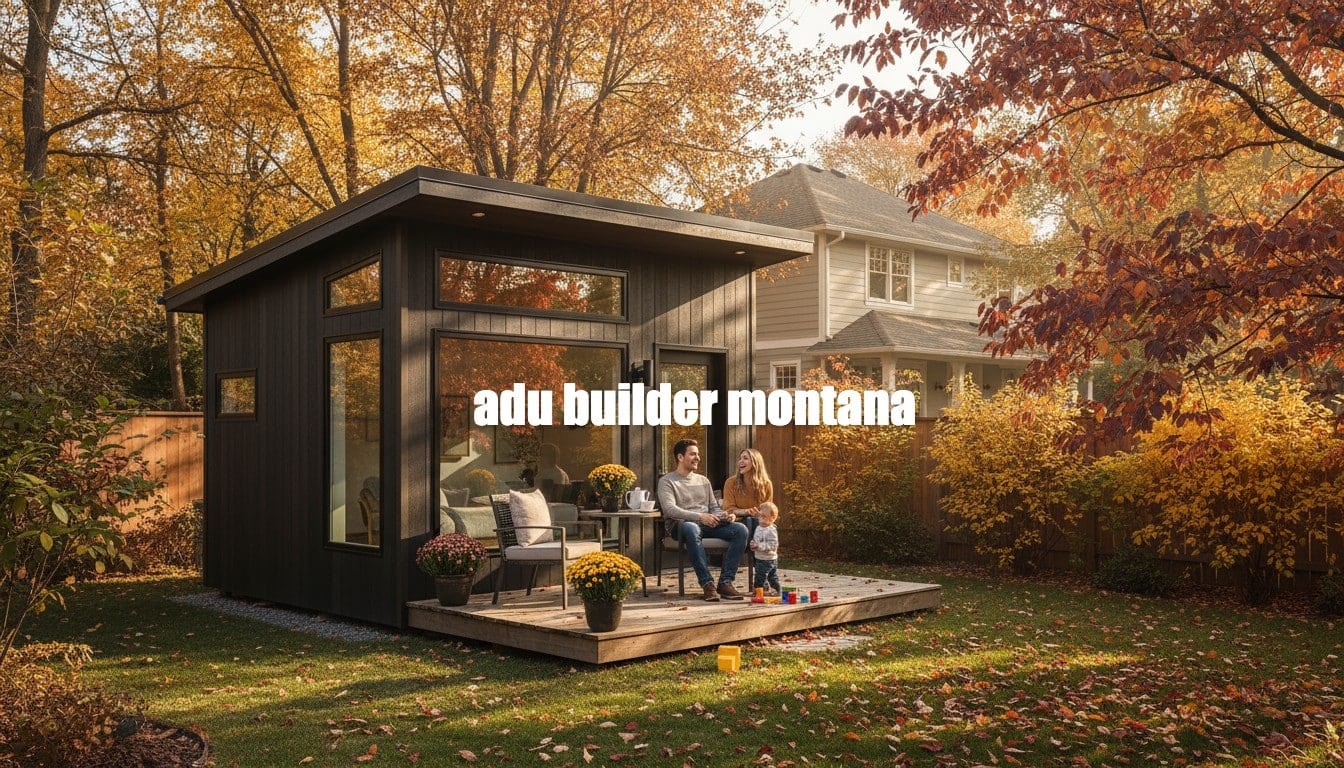
When we think about Montana’s housing challenges, we often picture the state’s stunning landscapes and growing population putting pressure on available housing stock. With home prices rising across cities like Bozeman, Missoula, and Billings, many of us are exploring innovative solutions to create additional living space on our properties. Accessory Dwelling Units (ADUs) represent one of the most promising approaches to address housing needs while potentially generating rental income or accommodating multi-generational families.
The financial stakes involved in ADU construction are significant – we’re typically looking at investments ranging from $150,000 to $400,000 or more, depending on size, location, and finishes. This substantial investment makes choosing the right builder absolutely critical. We’ve seen too many homeowners learn expensive lessons by working with contractors who lack ADU-specific experience, leading to permitting delays, cost overruns, and subpar results that fail to meet expectations.
What separates top-tier ADU builders from average contractors? Experience with local regulations, understanding of utility connections, expertise in maximizing small spaces, and knowledge of Montana’s unique climate considerations. The best builders navigate permitting processes efficiently, anticipate potential challenges, and deliver projects that not only meet code requirements but also provide excellent long-term value.
For homeowners considering smaller, more affordable alternatives to traditional ADUs, we should mention that granny pods and tiny homes offer compelling cost-effective solutions. While a traditional ADU might cost $200,000-$400,000, a well-designed granny pod can provide comfortable living space for $80,000-$150,000. When we compare this to assisted living costs averaging $4,000-$6,000 monthly in Montana, the financial benefits become clear – a granny pod can pay for itself in just 2-3 years while allowing families to stay together. These compact, efficient homes maximize functionality in smaller footprints, making them ideal for Montana properties where space and budget considerations matter.
Ready to explore your options? Book a call with our experts who have helped hundreds of customers make their tiny home dreams a reality.
Custom vs. Prefab ADU Builders: Which Is Right for Our Project?
When we’re planning an ADU project in Montana, one of our first major decisions involves choosing between custom-built and prefab options. Each approach offers distinct advantages and trade-offs that we need to carefully consider based on our specific needs, budget, and timeline.
Custom ADU Builders in Montana
Custom builders offer us complete design flexibility, allowing us to create ADUs that perfectly match our property’s architecture and our specific needs. In Montana, we’ll find custom builders who specialize in mountain contemporary styles, rustic designs that complement ranch properties, and modern farmhouse aesthetics popular in growing communities like Bozeman and Missoula.
Custom projects typically cost us $250-$500 per square foot, with total investments ranging from $200,000-$500,000 depending on size and finishes. The timeline for custom builds usually extends 12-18 months from initial design to completion, accounting for Montana’s shorter construction season and potential weather delays.
We gain several advantages with custom builders: unlimited design possibilities, ability to work around existing site constraints, integration with our main home’s architectural style, and optimization for Montana’s climate with features like enhanced insulation, snow load considerations, and efficient heating systems.
Prefab ADU Specialists
Prefab options offer us faster timelines and more predictable costs. While fewer prefab companies currently serve Montana compared to states like California, we’re seeing growing interest from manufacturers willing to ship to our region.
Prefab ADUs typically cost us $185,000-$350,000 for turnkey installation, with construction timelines of 6-9 months once permits are approved. These units arrive partially or fully assembled, reducing on-site construction time and weather-related delays.
The trade-offs include limited customization options, potential shipping costs to Montana locations, and designs that may not perfectly complement our existing architecture. However, prefab units often include energy-efficient features and modern amenities that work well for rental properties or guest accommodations.
How to Choose an ADU Builder: Essential Selection Criteria
Selecting the right ADU builder in Montana requires us to evaluate multiple factors beyond just cost and availability. We need builders who understand local regulations, have experience with Montana’s climate challenges, and can deliver quality results within our budget and timeline.
Licensing and Insurance Requirements
In Montana, we must verify that our chosen builder holds a valid contractor’s license through the Montana Department of Labor and Industry. We should confirm they carry general liability insurance with minimum coverage of $1 million, workers’ compensation insurance, and bonding appropriate for our project size.
We can verify licensing status through Montana’s online contractor database and should request current insurance certificates directly from the builder’s insurance provider. Never accept photocopies or outdated certificates – we need current, verified documentation.
ADU-Specific Experience
We should prioritize builders with demonstrated ADU experience over general contractors who primarily work on larger homes. Ask potential builders how many ADUs they’ve completed in Montana, request references from recent ADU clients, and review their portfolio of similar projects.
Experienced ADU builders understand space optimization techniques, utility connection requirements, and permitting processes that general contractors might find challenging. They also know which design elements provide the best return on investment for rental properties or family use.
Portfolio Review and Reference Checking
We should request to see completed ADU projects, preferably in person if they’re located nearby. Look for quality of finishes, attention to detail, and how well the ADU integrates with the main property. Ask about any challenges encountered during construction and how they were resolved.
When contacting references, we should ask specific questions: Did the project finish on time and on budget? How was communication throughout the process? Were there any unexpected issues, and how did the builder handle them? Would they hire this builder again?
The ADU Building Process in Montana: What to Expect
Understanding Montana’s ADU construction process helps us set realistic expectations and prepare for each phase of our project. While timelines can vary based on location, weather, and complexity, we can anticipate several distinct phases from initial planning to final occupancy.
Phase 1: Feasibility and Site Assessment (1-2 weeks)
Our builder will evaluate our property to determine ADU feasibility, examining setback requirements, utility access, soil conditions, and any site constraints. In Montana, they’ll also assess snow load requirements, drainage patterns, and access for construction equipment during different seasons.
Phase 2: Design and Planning (4-8 weeks)
Working with architects or designers, we’ll develop detailed plans that meet our needs while complying with local regulations. Montana’s climate considerations require attention to insulation values, heating systems, and snow load calculations.
Phase 3: Permitting (2-6 months)
Montana’s permitting timelines vary significantly between jurisdictions. Rural counties might process permits in 4-6 weeks, while cities like Bozeman or Missoula could require 3-6 months depending on workload and project complexity.
Phase 4: Construction (4-8 months)
Montana’s construction season typically runs from April through October, with winter work limited by weather conditions. Our builder will schedule foundation work, framing, utilities, and finishing based on seasonal considerations and material availability.
Phase 5: Final Inspection and Occupancy (2-4 weeks)
Building departments will conduct final inspections of electrical, plumbing, mechanical systems, and overall construction quality. We’ll also receive final utility connections and any required certificates of occupancy.
ADU Building Costs in Montana: Complete Budget Breakdown
Understanding ADU costs in Montana requires us to consider regional variations, seasonal factors, and the unique challenges of building in Big Sky Country. We’ll break down typical costs by region and project type to help you budget accurately for your ADU investment.
Regional Cost Variations
Montana’s ADU costs vary significantly by location. In Bozeman and the Gallatin Valley, we typically see costs of $200,000-$400,000 for complete ADU projects, driven by high demand and limited contractor availability. Missoula and surrounding areas generally range from $180,000-$350,000, while smaller cities like Great Falls or Billings might see costs of $150,000-$300,000.
Cost Breakdown by Component
Design and architecture typically account for 5-10% of total project costs ($10,000-$25,000). Permitting costs range from 2-5% ($3,000-$15,000), varying significantly between jurisdictions. Site preparation accounts for 5-15% ($10,000-$45,000) and includes excavation, utility trenching, and foundation work. Construction represents 60-70% of total costs ($120,000-$280,000) and covers framing, roofing, siding, insulation, and interior finishes.
Cost Per Square Foot by ADU Type
Detached new construction typically costs us $250-$500 per square foot, depending on finishes and complexity. Garage conversions generally cost $150-$300 per square foot since we’re working with existing structure. Prefab ADUs typically cost $200-$350 per square foot including installation.
Financing Options
Home equity loans and HELOCs offer us access to lower interest rates for ADU financing. Current rates in Montana range from 6-9% depending on our credit and loan terms. Cash-out refinancing might make sense if we can secure rates lower than our current mortgage. Construction loans provide funding during the building process, converting to permanent financing upon completion.
Montana ADU Regulations and Permitting: What Builders Must Navigate
Montana’s ADU regulatory landscape varies significantly between jurisdictions, creating challenges that experienced builders must navigate carefully. Unlike states with comprehensive statewide ADU legislation, Montana leaves most regulations to local governments, resulting in a patchwork of rules across different cities and counties.
Local Jurisdiction Variations
Bozeman allows ADUs in most residential zones with specific requirements: maximum 1,200 square feet or 75% of the primary dwelling size (whichever is smaller), minimum 5-foot setbacks, and owner-occupancy requirements. Missoula permits ADUs in single-family zones with size limits of 800 square feet or 40% of the primary dwelling. Billings allows ADUs as accessory uses in residential zones, with size limits typically around 1,000 square feet.
Common Permitting Requirements
Most Montana jurisdictions require building permits for new ADU construction, with fees ranging from $2,000-$10,000 depending on project size and location. We’ll typically need architectural plans, structural engineering, and site plans showing setbacks and utility connections.
Climate-Specific Code Requirements
Montana’s building codes require enhanced insulation values and heating systems rated for extreme cold. Snow load calculations are critical for roof design, with requirements varying by elevation and location. Foundation requirements account for frost penetration depths of 3-4 feet in most Montana locations.
ADU Return on Investment: Financial Benefits and Property Value Impact
Montana’s growing population and limited housing inventory create favorable conditions for ADU investments, though we need to understand regional variations and market dynamics to maximize our returns.
Property Value Increases
Montana ADUs typically increase property values by 15-25%, though this varies significantly by location and market conditions. In high-demand areas like Bozeman, well-designed ADUs can boost property values by $75,000-$150,000, while rural properties might see increases of $40,000-$80,000.
Rental Income Potential
In Bozeman, quality ADUs can generate $1,200-$2,500 monthly depending on size, finishes, and proximity to Montana State University. Missoula ADUs typically rent for $900-$1,800 monthly, with higher rates near the University of Montana. Smaller cities like Great Falls or Billings might see rental rates of $700-$1,400 monthly.
ROI Timeline Analysis
Montana ADU investments typically achieve cost recovery through rental income in 8-15 years, depending on construction costs and rental rates. A $200,000 ADU generating $1,500 monthly rental income would recover costs in approximately 11 years, not accounting for tax benefits or property value increases.
Common ADU Building Mistakes and How to Avoid Them
Learning from others’ mistakes can save us significant time, money, and frustration during our ADU projects. We’ve identified the most common pitfalls Montana homeowners encounter and strategies to avoid them.
Choosing the Wrong Builder Type
Many Montana homeowners make the mistake of hiring general contractors who lack ADU-specific experience, leading to inefficient designs, permitting delays, and cost overruns. We should prioritize builders with demonstrated ADU experience, even if they cost slightly more upfront.
Underestimating Total Costs
Montana homeowners frequently underestimate ADU costs by 20-30%, focusing only on construction costs while ignoring permits, utility connections, site preparation, and contingencies. We recommend budgeting 15-20% above initial estimates for contingencies.
Ignoring Local Regulations
Montana’s varied local regulations create confusion for homeowners who assume statewide standards apply everywhere. Before beginning design work, we should verify our local jurisdiction’s specific ADU requirements including size limits, setback requirements, parking needs, and design standards.
Poor Site Planning
Inadequate site analysis leads to problems with utility access, drainage, tree preservation, and construction access. We should conduct thorough site analysis including utility locations, drainage patterns, soil conditions, and seasonal access considerations.
Financing Your Montana ADU: Comprehensive Funding Guide
Securing appropriate financing for our Montana ADU project requires understanding various funding options and choosing the approach that best fits our financial situation and project timeline.
Home Equity Loans and HELOCs
Home equity loans provide fixed-rate financing based on our property’s current value minus existing mortgage balance. Current Montana home equity loan rates range from 6.5-8.5% depending on credit scores and loan terms. HELOCs offer more flexibility, allowing us to draw funds as needed during construction.
Cash-Out Refinancing
Cash-out refinancing replaces our existing mortgage with a larger loan, providing cash for ADU construction. This option makes sense when current mortgage rates are similar to or higher than new rates, or when we want to consolidate debt.
Construction Loans
Construction loans provide funding during the building process, with interest-only payments during construction and conversion to permanent financing upon completion. Montana construction loan rates typically run 1-2% higher than conventional mortgages.
Frequently Asked Questions About ADU Builders in Montana
How long does it take to build an ADU in Montana?
Montana ADU construction typically takes 6-18 months from initial planning to completion, depending on project complexity, permitting requirements, and seasonal factors. Custom builds generally require 12-18 months, while prefab units can be completed in 6-12 months once permits are approved.
How much does an ADU cost in Montana?
Montana ADU costs typically range from $150,000-$500,000 depending on size, location, finishes, and complexity. Cost per square foot generally ranges from $200-$500, with garage conversions on the lower end and custom new construction on the higher end.
Do I need an ADU specialist or can a general contractor build it?
We strongly recommend ADU specialists over general contractors for most projects. ADU specialists understand space optimization, utility connections, local regulations, and design challenges specific to smaller dwelling units.
How do I verify an ADU builder’s credentials?
We should verify Montana contractor licenses through the Department of Labor and Industry’s online database. Request current insurance certificates directly from insurance providers and check references from recent ADU clients.
Conclusion: Taking the Next Steps with Our Montana ADU Project
As we conclude our comprehensive guide to ADU builders in Montana, the most critical takeaway is the importance of choosing builders with specific ADU experience who understand Montana’s unique climate challenges, local regulations, and market conditions.
We’ve learned that successful ADU projects require careful planning, realistic budgeting, and thorough builder evaluation. Whether you choose custom or prefab construction, the builder’s expertise in space optimization, utility connections, and local permitting processes will significantly impact your project’s success.
Understanding costs and timelines helps set realistic expectations. Montana ADU projects typically cost $150,000-$500,000 and take 6-18 months to complete, with significant variations based on location, complexity, and seasonal factors.
Your 30-Day ADU Action Plan
Week 1: Research your local ADU regulations, verify property feasibility, and begin identifying potential builders. Week 2: Request quotes from 3-5 qualified builders, verify their credentials, and check references. Week 3: Evaluate financing options and refine your project scope. Week 4: Select your builder, finalize contracts, and begin the design process.
ADUs represent more than just additional living space – they’re solutions to Montana’s housing challenges, opportunities for multi-generational living, and investments in our communities’ future. With proper preparation and the right team, your ADU project can exceed expectations and provide lasting value for your family and community.
Ready to begin your ADU journey? Start by contacting qualified builders in your area for initial consultations and site assessments. The investment in professional guidance during planning stages will pay dividends throughout your project and for years to come.