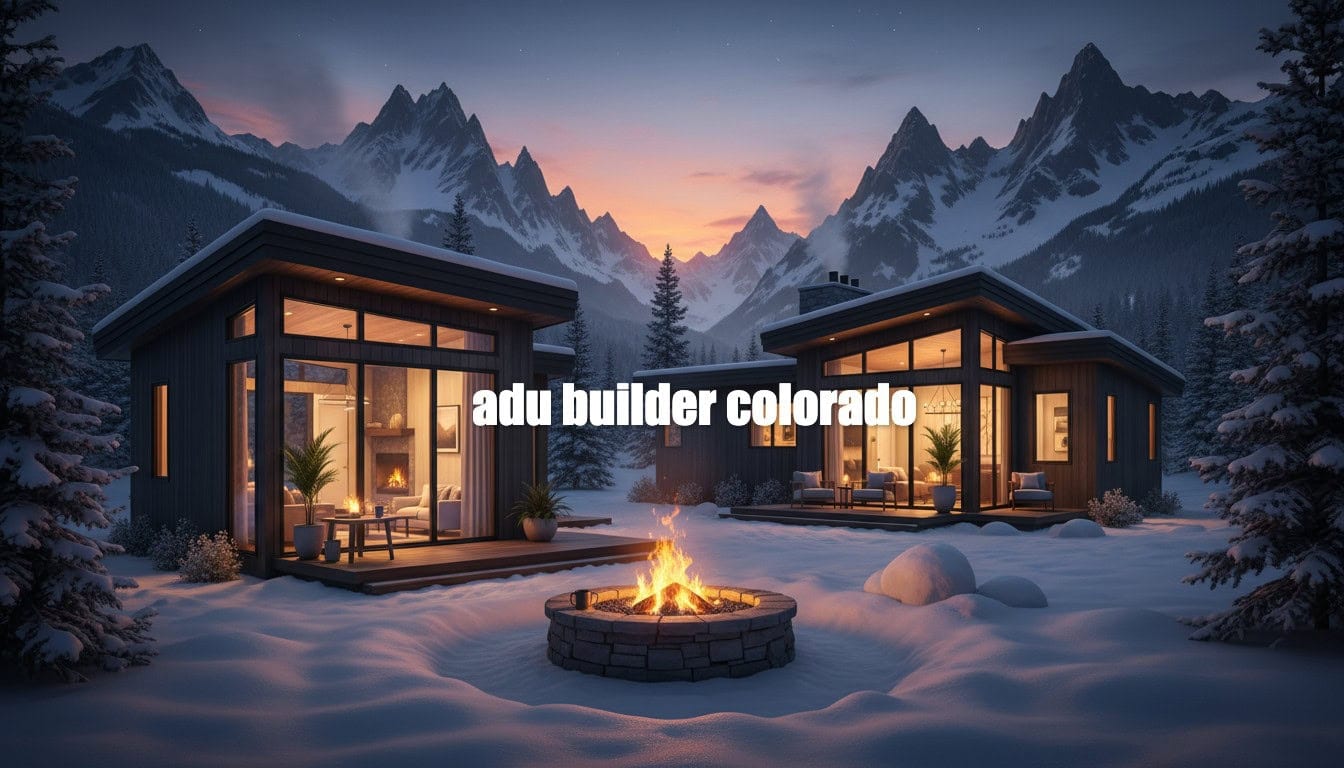
Colorado’s accessory dwelling unit (ADU) market has experienced remarkable growth, with cities like Denver, Boulder, and Fort Collins leading progressive housing policies. We’ve discovered that choosing the right ADU builder can mean the difference between a $200,000 investment that adds significant value to your property and a costly project that drains resources without delivering results.
The financial stakes are substantial. In Colorado, ADU projects typically range from $150,000 to $400,000, depending on size, location, and finishes. We’ve seen homeowners who selected experienced ADU specialists complete projects on time and within budget, while others who chose general contractors unfamiliar with ADU regulations faced delays, cost overruns, and permitting challenges that added months to their timeline.
What sets top-tier ADU builders apart? We’ve found that specialized ADU builders understand Colorado’s unique zoning requirements, have established relationships with local permitting offices, and can navigate complex utility connection processes that often trip up inexperienced contractors. They also provide transparent pricing, detailed timelines, and comprehensive warranties that protect your investment.
Through our research into Colorado’s ADU market, we’ve identified key factors that determine project success: builder specialization, local regulatory expertise, transparent communication, and proven track records. We’ve also discovered common pitfalls that can derail projects, from inadequate site assessment to poor contract terms.
As we’ve explored alternative housing solutions, we’ve found that granny pods and tiny homes offer compelling alternatives to traditional ADUs. These smaller, often prefabricated units can provide similar functionality at a fraction of the cost. While a traditional ADU might cost $300,000 or more, a well-designed granny pod can deliver comfortable living space for $80,000 to $150,000. When compared to assisted living facilities that can cost $4,000 to $6,000 monthly, a granny pod represents exceptional value for families seeking to keep loved ones close while maintaining independence.
At Great Lakes Tiny Homes, we understand the appeal of cost-effective housing solutions. Our experience with modular construction and space-efficient design has shown us how thoughtful planning can maximize functionality while minimizing costs. Whether you’re considering a traditional ADU or exploring alternatives like granny pods, the key is working with builders who understand your specific needs and local requirements.
Ready to explore your options? Book a call with our experts who have helped hundreds of customers make their tiny home dreams a reality.
Custom vs. Prefab ADU Builders: Which Is Right for Your Project?
When we evaluate Colorado’s ADU market, we see two distinct approaches: custom builders who create unique designs from scratch and prefab specialists who offer standardized units with limited customization. Understanding these differences is crucial for making the right choice for your property and budget.
Custom ADU builders in Colorado typically charge $250 to $500 per square foot. These builders work with architects to create designs tailored to your specific site conditions, aesthetic preferences, and functional requirements. We’ve found that custom builds excel when dealing with challenging lots, unique architectural styles, or specific accessibility needs.
Prefab ADU specialists offer a different value proposition. Companies operating in Colorado provide turnkey solutions ranging from $185,000 to $350,000, depending on size and finishes. These builders focus on streamlined processes, standardized designs, and faster installation timelines. We’ve observed that prefab units typically take 6 to 9 months from order to occupancy, compared to 12 to 18 months for custom builds.
The customization capabilities differ significantly between approaches. Custom builders can accommodate virtually any design request, from matching your home’s existing architecture to incorporating specialized features like home offices or art studios. Prefab builders typically offer limited customization options—perhaps 3 to 5 floor plan variations with predetermined finish packages.
Timeline differences often drive decision-making. Custom builds require extensive design phases, multiple permit revisions, and coordination between various trades. Prefab units arrive with pre-approved plans and standardized construction processes that reduce variables and potential delays.
For properties with standard rectangular lots, minimal site challenges, and straightforward utility access, prefab solutions often provide excellent value. Custom builds make sense for unique sites, specific architectural requirements, or when maximizing square footage within setback constraints.
How to Choose an ADU Builder: Essential Selection Criteria
We’ve developed a systematic approach for evaluating ADU builders that protects homeowners from costly mistakes while identifying contractors capable of delivering successful projects. Our framework focuses on verifiable credentials, demonstrated expertise, and transparent business practices.
Colorado contractor licensing requirements form the foundation of our evaluation process. We verify that builders hold current Colorado contractor licenses, maintain required bonding (typically $15,000 minimum), and carry comprehensive insurance including general liability ($1 million minimum) and workers’ compensation coverage. We also check the Better Business Bureau and Colorado Department of Regulatory Agencies for complaint histories.
ADU-specific experience separates specialists from general contractors attempting to enter this market. We look for builders who have completed at least 10 ADU projects and can provide detailed portfolios showing various unit types, sizes, and architectural styles. We also evaluate their familiarity with Colorado’s ADU regulations, local permitting processes, and utility connection requirements.
Portfolio review reveals construction quality, design capabilities, and attention to detail. We examine both exterior and interior photos, noting finish quality, space utilization, and overall craftsmanship. We also request references from recent clients and contact them to discuss their experience with timeline adherence, communication quality, and problem resolution.
Pricing transparency indicates professional business practices and helps avoid surprises. We expect detailed written estimates breaking down costs by category: design, permitting, site preparation, construction, utilities, and finishing. We’re wary of builders who provide only lump-sum bids or request large upfront payments before work begins.
Communication and project management capabilities become crucial during construction. We assess builders’ responsiveness during initial consultations, their use of project management tools, and their processes for handling changes or unexpected issues. We prefer builders who provide regular updates and maintain detailed project schedules.
Red flags we watch for include requests for large upfront payments (more than 10% before work begins), vague project timelines, absence of ADU-specific portfolio examples, and reluctance to provide detailed references. We’re also cautious about builders who seem unfamiliar with local ADU regulations or utility requirements.
The ADU Building Process in Colorado: What to Expect
We’ve observed that successful ADU projects in Colorado follow predictable phases, each with specific timelines and potential challenges. Understanding this process helps homeowners set realistic expectations and identify when projects are falling behind schedule.
Phase 1 involves feasibility and site assessment, typically requiring 1 to 2 weeks. Builders evaluate lot dimensions, setback requirements, utility access, soil conditions, and existing structures. We’ve found that thorough site assessment prevents costly surprises during construction. This phase should include utility location marking, preliminary soil testing, and zoning compliance verification.
Phase 2 encompasses design and planning, usually taking 4 to 8 weeks for custom builds or 2 to 4 weeks for prefab units. This phase includes architectural drawings, structural engineering, and utility planning. We recommend homeowners actively participate in design reviews to ensure the final plans meet their needs and comply with local requirements.
Phase 3 covers permitting, with timelines varying significantly by jurisdiction. Denver typically processes ADU permits in 2 to 4 months, while smaller municipalities might require 4 to 6 months. We’ve seen experienced builders navigate this phase more efficiently through established relationships and thorough permit package preparation.
Phase 4 involves actual construction, typically lasting 4 to 8 months depending on size, complexity, and weather conditions. This phase includes foundation work, framing, mechanical systems installation, and finish work. We’ve observed that Colorado’s weather can impact construction schedules, particularly during winter months.
Total timeline expectations range from 10 to 18 months for custom builds and 6 to 12 months for prefab units. We’ve found that realistic timeline planning includes buffers for weather delays, permit revisions, and change orders that commonly occur during construction.
ADU Building Costs in Colorado: Complete Budget Breakdown
We’ve analyzed ADU costs across Colorado’s major markets and found significant regional variations that impact project budgets. Understanding these cost factors helps homeowners budget accurately and avoid financial surprises during construction.
Regional cost variations reflect local labor rates, material costs, and permit fees. Denver metro area projects typically range from $200,000 to $400,000, while Boulder commands premium pricing of $250,000 to $450,000 due to strict building codes and limited contractor availability. Fort Collins and Colorado Springs offer more moderate pricing, with projects ranging from $175,000 to $350,000.
Cost breakdown by component reveals where money goes during ADU construction. Design and architecture typically consume 5% to 10% of total budget, permitting requires 2% to 5%, site preparation demands 5% to 15%, construction represents 60% to 70%, utilities account for 5% to 10%, and landscaping and finishing require 5% to 10%.
Cost per square foot varies by ADU type and construction method. Detached new construction typically costs $250 to $500 per square foot, garage conversions range from $150 to $300 per square foot, and prefab units fall between $200 to $350 per square foot. We’ve found that smaller units often have higher per-square-foot costs due to fixed costs being spread over less space.
Hidden costs frequently surprise homeowners who haven’t budgeted comprehensively. Utility connection fees can range from $5,000 to $15,000 depending on distance and capacity requirements. Impact fees vary by jurisdiction but can add $10,000 to $25,000 to project costs. Soil testing, tree removal, and setback variances can each add thousands to budgets.
Financing options include home equity loans with current rates around 7% to 9%, HELOCs offering variable rates starting around 6%, and cash-out refinancing when mortgage rates are favorable. Construction loans provide another option, typically requiring 20% to 25% down payment and converting to permanent financing upon completion.
Colorado ADU Regulations and Permitting: What Builders Must Navigate
We’ve studied Colorado’s evolving ADU regulatory landscape and found a patchwork of state guidelines and local ordinances that experienced builders must navigate successfully. Understanding these regulations helps homeowners appreciate why builder expertise matters.
Denver’s ADU regulations allow units up to 1,000 square feet or 125% of the primary dwelling’s floor area, whichever is smaller. Setback requirements include 5 feet from side and rear property lines, with additional restrictions near alleys. Parking requirements have been eliminated for most ADU projects, simplifying development in dense neighborhoods.
Boulder maintains stricter requirements, limiting ADUs to 1,000 square feet and requiring owner occupancy of either the primary dwelling or ADU. Design standards emphasize compatibility with existing neighborhood character, often requiring architectural review for visible ADUs.
Fort Collins allows ADUs up to 1,200 square feet with 5-foot setbacks from property lines. The city has streamlined permitting processes and eliminated parking requirements, making ADU development more accessible for homeowners.
Colorado Springs permits ADUs up to 1,000 square feet with standard residential setbacks. The city requires conditional use permits for detached ADUs, adding complexity and timeline to the approval process.
Permitting timelines vary significantly by jurisdiction and project complexity. We’ve observed that experienced ADU builders often achieve faster approvals through complete permit packages and established relationships with planning departments. Simple projects might receive approval in 60 days, while complex designs can require 120 days or more.
ADU Return on Investment: Financial Benefits and Property Value Impact
We’ve analyzed the financial performance of ADU investments across Colorado and found compelling returns that justify the substantial upfront costs. Understanding these financial benefits helps homeowners make informed investment decisions.
Property value increases from ADU additions typically range from 20% to 35% of the ADU’s construction cost. A $300,000 ADU might add $60,000 to $105,000 to overall property value, depending on location, design quality, and local market conditions. We’ve observed higher value increases in markets with strong rental demand and limited housing inventory.
Rental income potential varies significantly by location and unit quality. Denver metro area ADUs command $1,800 to $3,200 monthly rent, while Boulder units can achieve $2,200 to $3,800 monthly. Fort Collins and Colorado Springs typically see rents between $1,400 to $2,800 monthly, depending on size and amenities.
ROI timelines for cost recovery through rental income typically span 10 to 15 years, assuming consistent occupancy and market-rate rents. We calculate ROI by dividing annual net rental income by total project cost, including construction, financing, and ongoing maintenance expenses.
Alternative uses beyond rental income provide additional value. Multi-generational living arrangements can eliminate assisted living costs while keeping families together. Home offices can reduce commercial rent expenses and provide tax deductions. Guest accommodations can generate short-term rental income in tourist areas.
Common ADU Building Mistakes and How to Avoid Them
We’ve documented numerous ADU project failures across Colorado and identified recurring mistakes that cost homeowners thousands of dollars and months of delays. Learning from these errors helps ensure successful project outcomes.
Choosing general contractors over ADU specialists represents the most common and costly mistake we observe. General contractors often underestimate permitting complexity, lack relationships with local planning departments, and struggle with utility connection requirements specific to ADUs. We recommend selecting builders with demonstrated ADU expertise and local market knowledge.
Underestimating total costs leads to project delays and quality compromises. We’ve seen homeowners budget for construction costs but overlook permitting fees, utility connections, site preparation, and finishing expenses. We recommend adding 15% to 20% contingency buffers to initial budgets and obtaining detailed cost breakdowns from builders.
Ignoring local regulations and setback requirements can derail projects after construction begins. We’ve witnessed ADUs built too close to property lines, exceeding height restrictions, or violating design standards that require expensive modifications. We advise thorough regulatory research and professional site surveys before finalizing designs.
Poor site planning creates ongoing problems with drainage, utility access, and maintenance. We’ve seen ADUs positioned without considering sun exposure, prevailing winds, or access for emergency vehicles. We recommend comprehensive site analysis including topography, drainage patterns, and utility locations.
Inadequate contract terms and payment protections expose homeowners to financial risks. We’ve witnessed projects abandoned by contractors who received excessive upfront payments or contracts lacking specific completion timelines. We advise detailed contracts with milestone-based payments and clear performance standards.
Financing Your Colorado ADU: Comprehensive Funding Guide
We’ve researched financing options available to Colorado homeowners and found several viable paths for funding ADU projects. Understanding these options helps homeowners choose the most cost-effective financing strategy for their situation.
Home equity loans provide fixed-rate financing secured by property value, typically offering rates 1% to 2% above prime rate. Current rates range from 7% to 9% for qualified borrowers. These loans work well for homeowners with substantial equity who prefer predictable monthly payments over 10 to 30-year terms.
Home equity lines of credit (HELOCs) offer variable-rate financing with draw periods allowing flexible access to funds during construction. Current rates start around 6% but can fluctuate with market conditions. HELOCs suit homeowners who want to pay interest only on funds used and prefer flexibility during construction phases.
Cash-out refinancing replaces existing mortgages with larger loans, providing cash for ADU construction. This option makes sense when current mortgage rates exceed new loan rates or when homeowners want to consolidate debt. We’ve seen this strategy work well for homeowners with low existing mortgage balances.
Construction loans provide short-term financing during building phases, typically converting to permanent financing upon completion. These loans require 20% to 25% down payments and charge interest only on funds disbursed. We recommend this option for homeowners without sufficient equity for other financing methods.
Specialized ADU financing programs have emerged from companies like RenoFi and local credit unions. These programs often offer streamlined approval processes and competitive rates for ADU projects. Some programs consider projected rental income when qualifying borrowers, enabling higher loan amounts.
Frequently Asked Questions About ADU Builders in Colorado
How long does it take to build an ADU in Colorado?
We typically see ADU construction timelines ranging from 6 to 18 months, depending on project type and complexity. Prefab units generally require 6 to 9 months from order to occupancy, while custom builds take 12 to 18 months. Permitting phases can add 2 to 6 months depending on jurisdiction and design complexity.
How much does an ADU cost in Colorado?
We’ve observed ADU costs ranging from $150,000 to $500,000 depending on location, size, and finishes. Denver metro area projects typically cost $200,000 to $400,000, while Boulder commands premium pricing up to $500,000. Garage conversions start around $150,000, while detached new construction begins around $250,000.
Do I need an ADU specialist or can a general contractor build it?
We strongly recommend ADU specialists over general contractors for these projects. Specialists understand local ADU regulations, have established relationships with permitting offices, and possess experience with utility connection requirements. General contractors often underestimate complexity and timelines for ADU projects.
What’s the difference between custom and prefab ADU builders?
Custom builders create unique designs tailored to specific sites and preferences, typically costing $250 to $500 per square foot and requiring 12 to 18 months completion. Prefab builders offer standardized designs with limited customization, typically costing $185,000 to $350,000 turnkey and requiring 6 to 9 months completion.
How do I verify an ADU builder’s credentials?
We recommend checking Colorado contractor license status through the Department of Regulatory Agencies website, verifying insurance coverage and bonding, reviewing Better Business Bureau ratings, and contacting recent client references. We also suggest examining portfolios of completed ADU projects and visiting job sites when possible.
What warranties should ADU builders provide?
We expect minimum one-year workmanship warranties covering defects in construction and materials. Structural warranties should extend 10 years, and major systems (HVAC, plumbing, electrical) should carry manufacturer warranties plus installation guarantees. We also look for responsive warranty service and clear claim procedures.
Conclusion: Taking the Next Steps with Your Colorado ADU Project
We’ve covered the essential elements of successful ADU projects in Colorado, from selecting specialized builders to understanding costs, regulations, and financing options. The key takeaways we want to emphasize include the critical importance of choosing ADU specialists over general contractors, budgeting comprehensively for all project phases, and understanding local regulations that affect design and permitting.
Our research shows that Colorado’s ADU-friendly regulatory environment and strong rental markets create excellent opportunities for homeowners willing to invest in quality construction. The combination of property value increases and rental income potential provides compelling returns that justify the substantial upfront investment.
For immediate next steps, we recommend beginning with site feasibility assessments from qualified builders, requesting detailed quotes from 3 to 5 ADU specialists, and verifying credentials through license checks and reference interviews. We also suggest reviewing portfolios carefully and visiting completed projects when possible.
The financing landscape offers multiple options for funding ADU projects, from traditional home equity products to specialized ADU lending programs. We encourage homeowners to secure financing pre-approval before selecting builders to maintain negotiating flexibility and ensure project feasibility.
Our final advice centers on trusting expertise while verifying everything. The most successful ADU projects we’ve observed combine experienced builders, realistic budgets, and homeowners who stay engaged throughout the process. Planning for contingencies and maintaining open communication help navigate the inevitable challenges that arise during construction.
Whether you’re considering a custom design that maximizes your unique site or a prefab solution that prioritizes speed and cost efficiency, the key is starting with thorough research and qualified professionals. We encourage you to begin with free consultations from top builders in your area and take the first steps toward realizing your ADU vision.